What is MCP ??
The Model Context Protocol (MCP) is an open standard designed to create a secure, standardized, two-way communication channel between large language models (LLMs) and external tools, data sources, and services. It acts as a universal “language” that allows AI agents to access real-time information and take action beyond their training data, significantly reducing “hallucinations” and increasing their overall utility. By standardizing this interaction, MCP simplifies the development of complex AI agents that can connect to and perform tasks across various systems like databases, business software, and web services.
Terraform MCP
Now that the Terraform MCP server is being worked on (still in beta now), it is a game-changer for IaC development, enhancing AI models with direct, real-time access to the latest Terraform information, fundamentally solving the problem of AI relying on outdated training data. This is the true end of the copy paste workflow resulting from outdated ChatGPT responses.
What the Terraform MCP Server Delivers
The Terraform MCP server implements the MCP specifically for the Terraform ecosystem, offering key benefits. It ensures Real-time Accuracy by accessing the most current provider documentation from the Terraform Registry, eliminating reliance on stale training data—it’s like giving your AI the cheat sheet for the latest release. It provides Deep Integration by connecting directly with public Terraform Registry APIs for providers, modules, and policies. For enterprises, it offers essential Enterprise Support, including full support for HCP Terraform & Terraform Enterprise, workspace management, and private registry access. Finally, it delivers Actionable AI, enabling the model to perform concrete Workspace Operations (create, update, delete) and manage variables, tags, and runs, elevating AI from a consultant to an executor.
Giving back the precious time of Cloud People
The introduction of the MCP server fundamentally shifts how IaC developers spend their valuable time. Instead of dedicating hours to low-value, error-prone tasks like manually checking the latest provider documentation, cross-referencing module inputs, or debugging configurations generated from stale code snippets, developers can now trust the AI’s output.
This freedom allows developers to focus their efforts on high-value, strategic tasks, like Architecture and Design, optimizing cloud infrastructure for cost, performance, security… Basically Building and Innovating rather than fixing syntax errors.
The MCP server handles the mundane task of keeping configurations up-to-date and syntactically correct, liberating cloud people to become true cloud strategists.
How It Changes the IaC Game
The core change is in the source of truth used by the AI when generating configurations.
| Scenario | AI Prompt | AI Response Generation (Internal Process) | Outcome |
|---|---|---|---|
| Without MCP Server | “Create an Azure Resource Group named prod-rg in East US.” | AI relies solely on its static training data (which might be months old) to recall the syntax for the azurerm_resource_group resource. | Syntax Risk: If Azure/Terraform changed the required arguments or default values since the training data was compiled, the generated code might be outdated or incorrect. |
| With MCP Server | “Create an Azure Resource Group named prod-rg in East US, ensuring all tags are applied from the ‘Project-X’ variable set.” | AI uses an MCP tool to query the Terraform Registry in real-time for the current syntax of the azurerm_resource_group resource. It then uses the HCP/TFE MCP tool to retrieve the current ‘Project-X’ variable set and applies them. | Accuracy & Actionability: The code is generated using the latest official provider syntax and correctly interacts with a live HCP/TFE variable set, resulting in a current, compliant, and ready-to-run configuration. |
Even Better
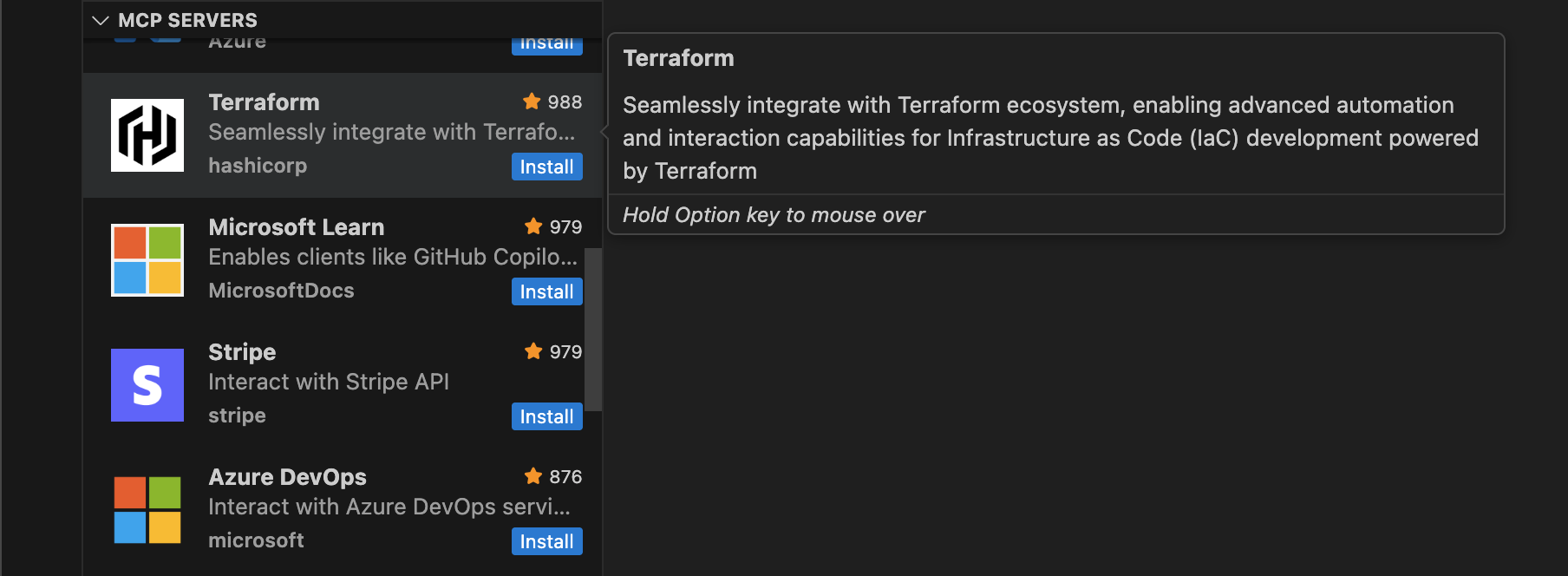
The Terraform MCP Server is available in VS Code and Github Codespaces, So you can already play around with it, don’t break your Infra though, it s still in Beta 😅
This is the beginning of true AI Driven Infrastructure as Code.